Article · positioning
Positioning from evidence, not aspiration
mimklamra treats positioning as a set of claims that can survive a skeptical buying committee. The inputs are patterns from research—not wishlist adjectives or borrowed QuickBooks-adjacent buzzwords.
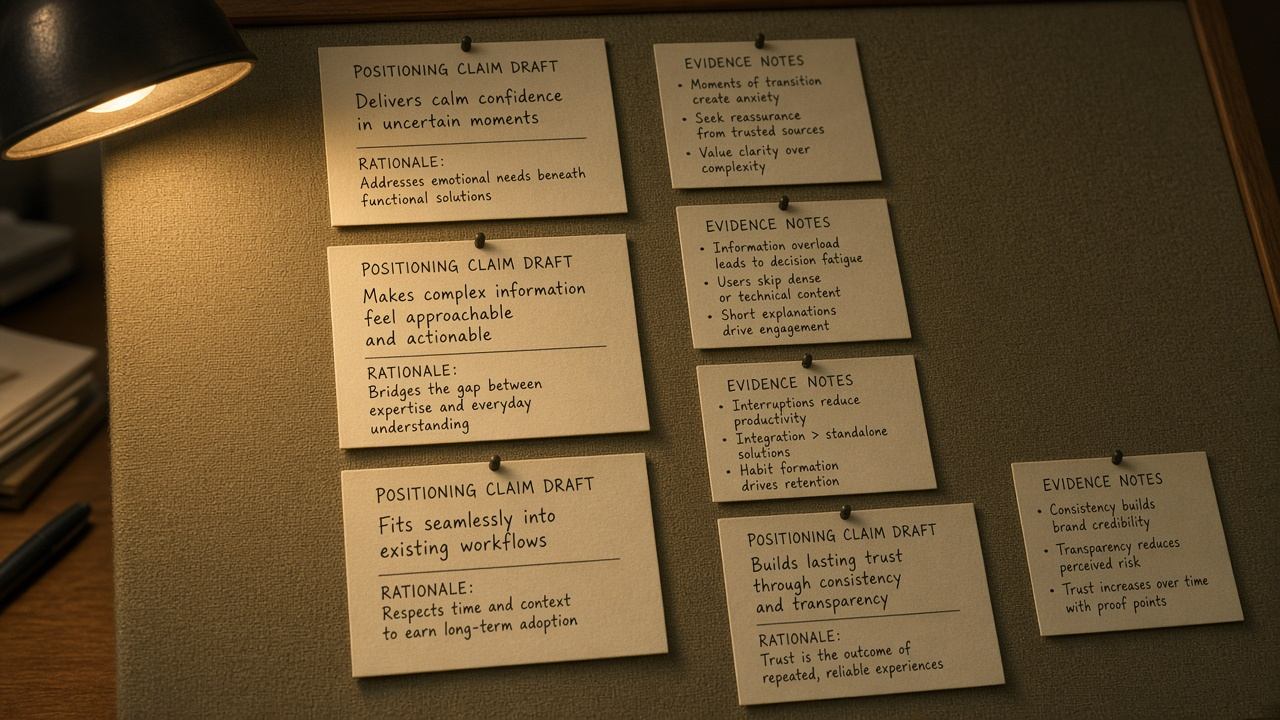
Claim anatomy
Every candidate claim needs four parts: who it is for, the job it addresses, the mechanism that makes it credible, and the risk it refuses to deny. “For controllers cleaning messy multi-entity books, we reduce import rework by making source mismatches visible before close” is a claim with a mechanism. “The modern finance OS” is not.
Pull mechanisms from pattern synthesis. Pull risk language from friction maps. If buyers compare everything to QuickBooks, your positioning must either coexist with that gravity or explain the migration labor without theatrical ROI promises.
Stress-testing claims
Read claims aloud in follow-up interviews. Ask what feels overstated. Ask what a CFO would challenge. Ask which competitor phrase already occupies the same mental shelf—often discovered via market signal observation. Retire claims that require buyers to believe something they have never seen in their process.
Document discarded drafts in field notes so teams do not resurrect them six weeks later. Positioning is iterative editing under evidence constraints.
Evidence vs hype
Keep
- Job-to-be-done phrasing from interviews
- Named friction the product actually reduces
- Proof types buyers requested (artifacts, rituals)
- Honest scope limits
Drop
- Unmeasured ROI percentages
- “Representative” claims from tiny samples
- Category clichés with no mechanism
- Promises that contradict adoption labor
A one-page positioning brief
mimklamra recommends a single page: segment, primary job, three claim candidates with source links, top objections, and “do not say” lines. Attach the touchpoint map nodes where each claim will appear. If a claim has no home on the journey, it is decoration.
Positioning is the discipline of saying less—with receipts.
Revisit the brief after every research wave. Evidence ages. Competitors move. Buyer language drifts. The glossary on mimklamra keeps shared vocabulary stable while claims evolve—see glossary.